

Can India Reverse Its Reading Recession? Rethinking How We Read and Learn
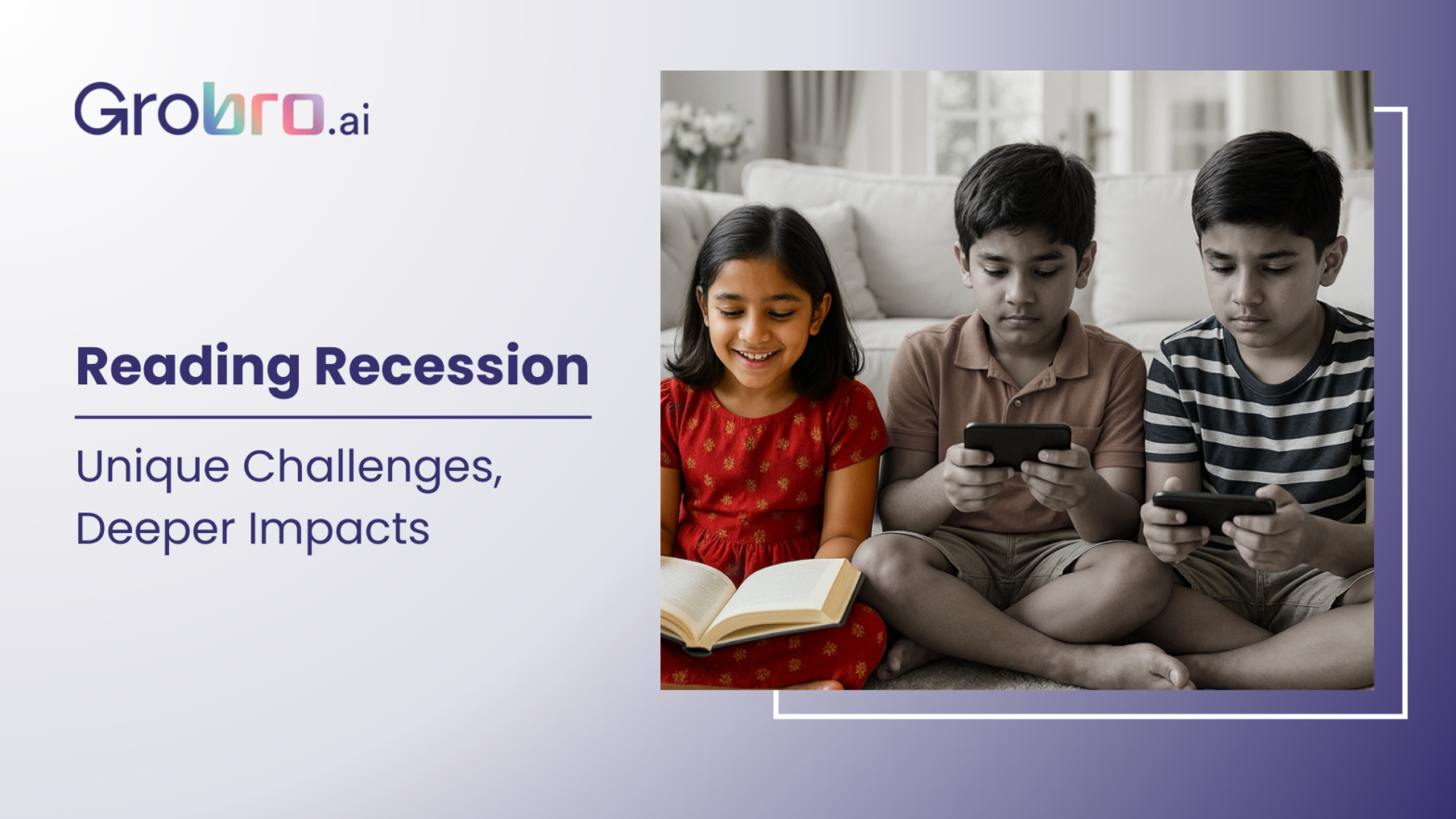
India’s reading slowdown is real. See a five-point plan and how a data-driven reading framework matches the right book to the right child at the right time.
In a country that takes pride in its literary heritage, from the epics of the Mahabharata to the works of Premchand and Tagore, a quiet crisis is unfolding. Indian children are reading less deeply, less regularly, and with less comprehension than ever before.
The shift from books to screens, from focused attention to endless scrolling, is not only changing what children read but also how they read. It’s reshaping how they think, feel, and learn. Globally, educators and researchers have started referring to this shift as a “reading recession.”
But can India, with its massive school-going population, reverse this trend? And more importantly, can we rethink how we measure and nurture reading in a way that’s responsive to 21st-century challenges?
The Warning Signs: Are We in a Reading Recession?
Although India’s literacy rate has steadily climbed, reading proficiency hasn’t kept pace. Multiple national and international assessments, such as ASER, NAS, and PISA, have shown that many Indian students struggle to read grade-appropriate texts with understanding.
But this isn’t just a school problem, it’s a cognitive and cultural shift driven by:
- Digital distractions: The average screen time among Indian children has risen sharply post-pandemic, replacing sustained reading with short-form content and passive consumption.
- Shallow engagement: Constant scrolling reduces the brain’s capacity for deep comprehension and critical thinking.
- Lack of personalised instruction: Most reading assessments still operate on broad age-based categories, not accounting for real-time ability levels or reading environments.
This signals a dangerous paradox. More content access, but less meaningful reading.
The Indian Context: Unique Challenges, Deeper Impacts
Unlike many Western nations, India faces multi-layered barriers that exacerbate the reading crisis:
- Linguistic diversity: With 22 official languages and hundreds of dialects, India’s reading ecosystem is fragmented.
- Socio-economic inequality: Millions of children don’t have access to age-appropriate books, let alone level-appropriate ones.
- Rote-learning culture: In many classrooms, reading is reduced to pronunciation drills or textbook repetition, not comprehension or joy.
- Assessment gaps: Current tools fail to capture whether a child can actually understand what they read, and what text would best match their ability.
So how do we solve for this?
Measuring What Matters: Why Reading Ability Must Be Personalised
To reverse the reading recession, we need to rethink how we define and measure reading proficiency.
Traditionally, reading levels are aligned with chronological age or grade, assuming that all 8-year-olds should be reading the same kind of books. This approach fails to capture the wide variation in individual learning trajectories.
Instead, modern research advocates for reading measurement frameworks that focus on:
- A child’s actual reading ability
- The difficulty level of texts
- The alignment between the two
This alignment, often referred to as “the right book to the right child at the right time”, is critical for improving comprehension, confidence, and long-term literacy. Deep reading builds attention and inference. Level-matched texts keep the brain in an optimal challenge zone, which supports comprehension growth over time.
A Homegrown Solution: GroQuotient Framework
In India, one such promising solution is the GroQuotient (GQ) Framework by GroBro.ai, an AI-driven system designed to measure both the reading ability of a learner and the complexity of a given text.
Here’s how it works:
GQ Test: Measuring Reading Ability
- Students take a short, adaptive reading test featuring stories, nonfiction texts, and comprehension questions.
- The test measures not just accuracy but depth of understanding, including inference, sequencing, vocabulary, and reasoning.
- Results generate a personalised GQ Score, representing the student’s current reading ability.
GQ-tagged Texts: Measuring Text Difficulty
- Books and passages are analysed using GQ’s proprietary tagging engine that evaluates sentence structure, vocabulary density, and conceptual depth.
- Each book gets a GQ Level, enabling educators and parents to match books accurately to the learner’s ability.
Right Book, Right Child, Right Time
- When a child’s GQ Score matches a text’s GQ Level, reading becomes productive, not frustrating or boring. This maximises engagement, builds reading stamina, and strengthens core literacy skills.
- The GQ Framework doesn’t replace the role of educators, it empowers them with the data to tailor learning pathways for every child.
What We Must Do Next: A Five-Point Strategy
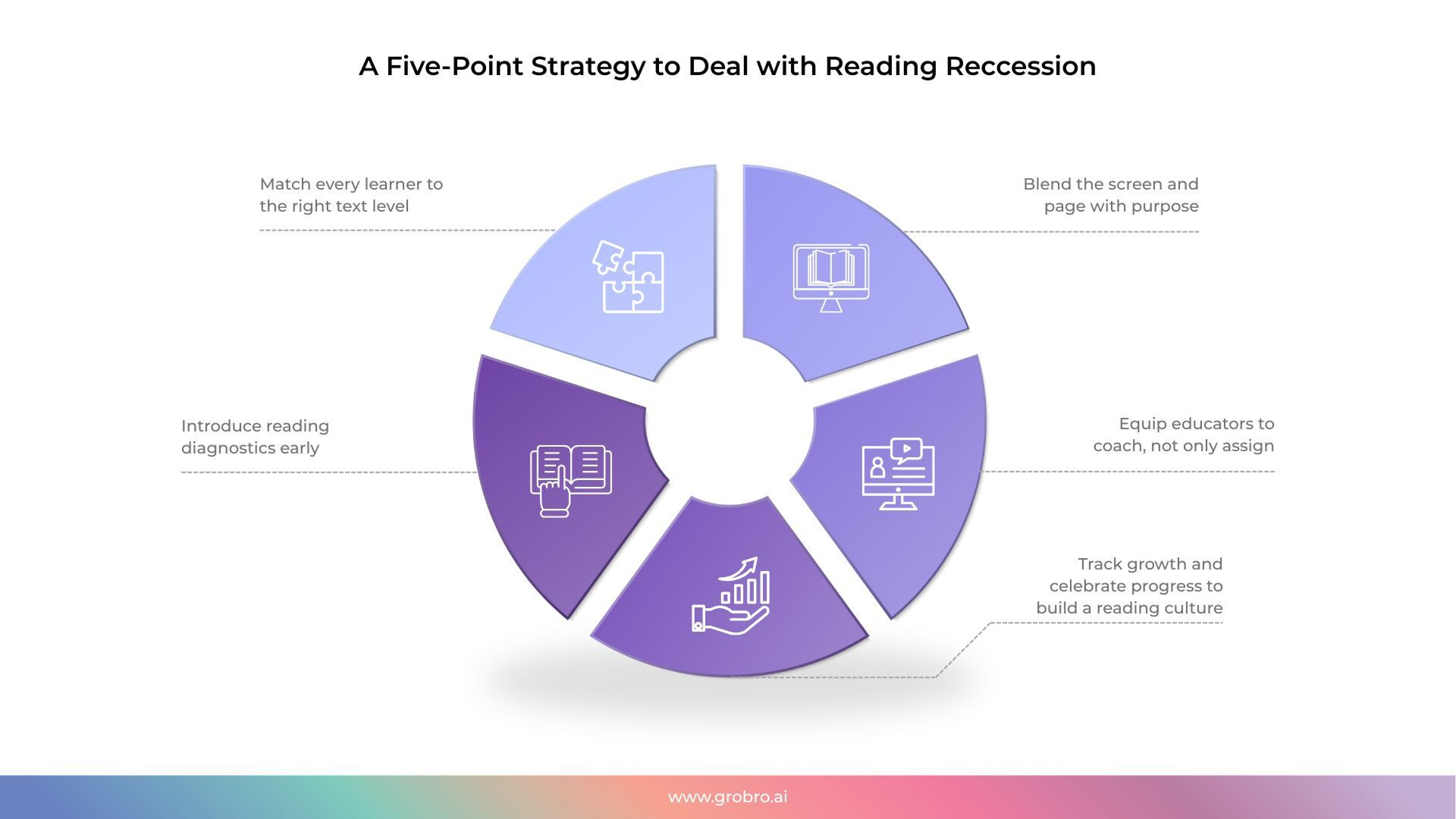
To reverse India’s reading recession, we need a national literacy strategy that moves beyond slogans and toward data, personalization, and joy. Here’s what it could look like:
1. Introduce reading diagnostics early
Implement tools like the GQ Test at age 8+ to get real-time reading baselines. Without a baseline, instruction stays generic. Early diagnostics help prevent the slow slide into a reading recession.
2. Match every learner to the right text level
Mismatch is the quickest way to kill motivation. Books that are too easy or too hard lower time-on-task and retention. Publishers, libraries, and EdTech platforms must label books by difficulty level, not just by grade or age.
3. Blend the screen and page with purpose
Screens are here to stay. The goal is not to ban them but to convert them into bridges to book reading. Leverage AI-integrated tools like GroBox that use digital platforms to drive real-world book reading.
4. Equip educators to coach, not only assign
Teachers should be supported to use reading-level frameworks to curate classroom libraries and assign texts. Matching books is step one. Guided talk and feedback turn reading into learning. Train teachers to use GQ data for small-group instruction and provide two or three talk moves for home use: What surprised you? What would you change? Which part felt real?
5. Track growth and celebrate progress to build a reading culture
Reading isn’t a race. National campaigns should reward growth, whether that’s moving from picture books to chapter books or from basic comprehension to analytical thinking. Habits grow when effort is visible, and success feels attainable.
Conclusion: From Crisis to Possibility
India doesn’t need to follow global trends into a reading recession. We can choose a different path, one that honours our storytelling legacy while embracing tools that personalise and strengthen reading for every child.
By rethinking how we define, measure, and support reading, and using tools like the GroQuotient Framework to put data into action, we can make sure that no child is left behind, overwhelmed, or under-read. Because every child deserves a book that speaks to them, not just at them.
